IT Security / Networks and Systems, Master 1 subject

  • How can information be represented, saved, transmitted and processed?
  • Which system (Internet, computer networks, mobile phones, cars etc.) vulnerabilities are there and when are systems vulnerable?
  • How do complex IT systems stay safe in accordance with pre-defined safety objectives (privacy, integrity, authenticity, anonymity)?
  • How do cryptographic processes work (e.g. data encryption, digital signatures) and how are they implemented?
  • How can systems be protected against hacker attacks?
  • What are the challenges concerning the interface human/IT Security
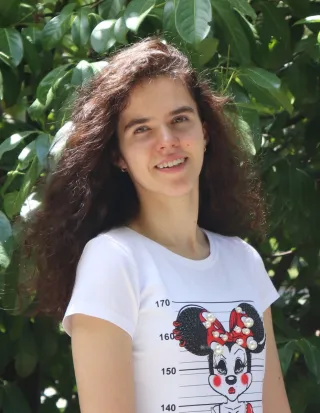
Plamena Hristova

Analysing attack scenarios and security protocols is great fun. To gain a better understanding of security vulnerabilities, you need to think like an attacker. All of this is both exciting and exhausting at the same time.

Plamena Hristova  – Bachelor
Plamena Hristova

What made you choose this degree programme?

Logic and mathematics have always sparked my interest in everyday life, and cyberspace has fascinated me for a long time.

In which respect have or haven’t your expectations been fulfilled?

Dealing with many algorithms and security concepts is very important to me. There is a significant amount of theory and sometimes the practical application is missing, but overall the modules are as well structured as possible. 

Which aspect of your degree programme do you enjoy most?

Analysing attack scenarios and security protocols is great fun. To gain a better understanding of security vulnerabilities, you need to think like an attacker. All of this is both exciting and exhausting at the same time. 

What has been your biggest challenge to date?

Understanding and accepting that you cannot be perfect and that you may fail from time to time. You invest a lot of time and effort in this degree programme, but the hard work will pay off eventually. You should learn to believe in your abilities and knowledge; the results will come sooner or later anyway. 

What would you like to become after completing your degree?

A person who uses their knowledge to help make the world a little bit better and cyberspace a little bit safer.

Which advice would you like to give to students who consider enrolling in this degree programme?

You should be interested in the modules offered by this degree programme, but to find out whether you will enjoy it, it is best to give it a try. Do not rely on other people's opinions; experience ITS for yourself and break down stereotypes, because ITS may be just the thing for you.

Profile

Degree
Master of Science
Start
Winter- and summer semester
Duration
4 semesters
Classroom language
German, English
Admission
Not restricted, application service
Information on enrollment/application for German applicants

Information on enrollment/application for German applicants

Application information for international applicants

Application information for international applicants

What's it all about?
This degree programme is unique, because ...
you will gain in-depth knowledge in the field of IT security based on the three-pillar model of computer science, information technology and cryptography. We are Europe's leading location for academic education in the field of IT security. You will learn from world-leading experts in cybersecurity and become part of a unique ITS ecosystem with direct links to renowned research institutes such as the world-famous Horst Görtz Institute for IT Security with its CASA cluster of excellence and the neighbouring Max Planck Institute for Security and Privacy.
It provides the opportunity to specialise in the following fields ...
  • Network and Data Security
  • Embedded Security
  • Cryptography
  • System Security
  • Security Engineering
  • Human-Centred Security
  • Mobile Security
Who is suited?
Those who wish to enrol in this degree programme,
have:
  • substantial understanding of computer science, information technology and mathematics

enjoy:

  • logical reasoning
  • understanding technological principles, making new discoveries and creating new designs, and promoting innovation

struggle through:

  • different problems and scientific issues
This degree programme is suited for graduates in the following subjects
  • Computer Science
  • Information Technology
  • Electrical Engineering
  • Mathematics
  • Physics
  • related subjects
Graduates from this degree programme frequently work
  • as a security engineer in various industries: automotive, energy and environment, aerospace, public service, telecommunications, medical technology, critical infrastructure
  • as a penetration tester/ethical hacker
  • as an incident response specialist
  • as an IT forensic expert
  • in research and development
  • as an IT security consultant
  • as a system developer
  • as a data protection officer
  • as a manager
And else?
An internship ...

is optional.

Where do I find help?
Academic advisory office

Building, Room: MC 1/36 bzw. 1/37

E-mail: informatik-studienberatung@rub.de

Website academic advisory office

Contact students

Fachschaft: IT-Sicherheit

Building, Room: MC 0/68

Website Fachschaft

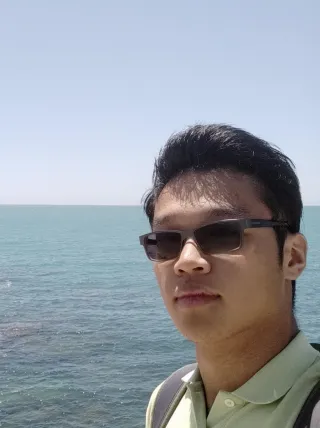
Jia-Lin Shi

I was looking for an exciting and meaningful field to specialise in, and I found exactly that in the world of cybersecurity.

Jia-Lin Shi  – Master of Science
Jia-Lin Shi

What made you choose this degree programme?

When I decided on my field of study, there were two key reasons that influenced my decision. During my bachelor's degree in computer science, I developed a strong interest in cybersecurity, especially after watching a documentary about the Stuxnet incident. I was looking for an exciting and meaningful field to specialise in, and I found exactly that in the world of cybersecurity.

In which respect have or haven’t your expectations been fulfilled?

My expectations of the subject were met in many respects. I gained insights into various topics and was able to delve deeper into certain areas, particularly thanks to a wide range of high-quality elective courses. I also appreciated the practical application of mathematics. However, there were some areas, such as network security beyond TLS, that were not covered and did not fully meet my expectations.

Which aspect of your degree programme do you enjoy most?

Figuring out and implementing the ‘right’ exploits in practical tasks is what I enjoy most about my subject. It's challenging, but also extremely satisfying when you find a solution and make it work.

What has been your biggest challenge to date?

The biggest challenge so far has definitely been the heavy workload required to thoroughly explore the topics. It took a lot of time and commitment to succeed, and it can be frustrating to fail several times before coming up with the winning idea.

What would you like to become after completing your degree?

As far as my future career plans are concerned, I don't have any concrete ideas at the moment. However, I would like to contribute to society and use my cybersecurity skills to protect people and organisations from threats.

Which advice would you like to give to students who consider enrolling in this degree programme?

For anyone thinking about studying my subject, I have a few tips. Network with other students from your lectures to help and support each other, because most of them will feel just as clueless and lost as you do at some point. You are not alone, and it is important to seek support from fellow students, lecturers and professors, or institutional bodies such as student advisory services and the student council, as they are friendly and helpful.